
Product. Presentation. Result
“The Power of Cultural Heritage in Destination Marketing” – I’ve wanted to write about this for a long time. Thanks to the Christmas holiday, I finally found the time and got it down on paper. Actually, seeing Krakow provided some inspiration too. I was finally able to write about the “Hercules” (Herakles) topic I discussed with my dear friend Architect Cüneyt Bey. It’s a bit long, but I hope you won’t get bored.
I want to tell you about a real story.
Becoming a brand is essential for cities. Product forms the foundation of this brand. A marketable product with a story that leaves an impression on visitors.
Some cities are very fortunate in this regard. Products are abundant.
Even a simple grave can be a powerful attraction. Masses of people go, find that grave, and visit it. These visitors are tourists who eat, drink, and spend. They add economic value to the destination (Ashworth & Page, 2011).
Wieliczka: Transforming Underground White Gold into Experience
Some cities create such a product that it blows your mind.
Krakow, Poland has long been one of the top 10 places on my list. We kept postponing it, saying the children were small and would be affected. You know the place: Auschwitz-Birkenau.
We came to Krakow but still didn’t go there.
However, we went to something else: “The Salt Mine.”
Yes, you read that right. Do you visit a salt mine on vacation?
Yes, you do. This is where the real story begins.
Wieliczka Salt Mine: The Hidden Treasure Underground
The Krakow city square itself is already magical, like something from Czech films. The entire square and its surroundings are one of the first 12—one of the first 12 World Heritage Sites. This salt mine is reached by approximately 25 minutes of regular train travel from the city center. Last stop. You just follow the crowd and flow toward a miracle hidden in the depths of the earth for centuries. Wieliczka Salt Mine is not just a mine—it’s an underground cathedral carved into rock, a work of art sculpted from salt, and one of the brightest pages of Europe’s industrial memory (Dobrowolski & Tyszka, 2015).
Every product has a story. You cannot market a product without a story (Fog, Budtz & Yakaboylu, 2005).
In the early 13th century, perhaps even earlier, when miners first began digging in this land, what they encountered was no ordinary salt deposit. The legend begins with a ring brought as dowry by Hungarian Princess Kinga. She threw her ring into a salt mine in Hungary, and when she came to Poland, that ring was found here, inside the salt. True or fairy tale? Perhaps both—because Wieliczka itself is already like a fairy tale (UNESCO World Heritage Centre, 1978).
White Gold: Salt as the Foundation of Economy
Records mention the year 1044, but the real development began in the 13th century when Krakow became Poland’s capital. (When dates from the 1000s are mentioned, I always think of comparisons with our arrival in Anatolia.) Salt was as valuable as gold back then—indispensable for preserving food, seasoning, and sustaining life. Salt was called “white gold,” and Wieliczka was precisely its source (Wollenberg, 2013).
In the past, newborn babies were salted. My mother used to salt the cows in the highland pastures, salt the cheese curds, salt the sacrificial animal hides. I think it was indispensable for nomads too. (This is our way.)
For seven centuries, generation after generation, miners deepened this underground labyrinth. Reaching 327 meters in depth, corridors exceeding 300 kilometers, nine levels, countless chambers… In 1978, it became one of the first twelve sites inscribed on the UNESCO World Heritage List. Here emerged the unique convergence of history, nature, and human labor (Pawlikowski, Loska & Róż, 2015).
Europe’s Sacred Treasure
Wieliczka’s importance to Europe is multilayered, just like the mine itself. Economically, it was one of the most important revenue sources of the Polish Kingdom during the Middle Ages and Renaissance. This mine played a major role in Krakow’s golden age and in the construction of magnificent cathedrals and palaces.
But beyond economics, Wieliczka is a monument to the incredible skill and endurance of European miners. The mining techniques, safety systems, and ventilation methods developed here spread throughout Europe. This place taught how to build underground cities and how to extract and process salt (Thiel, 2010).
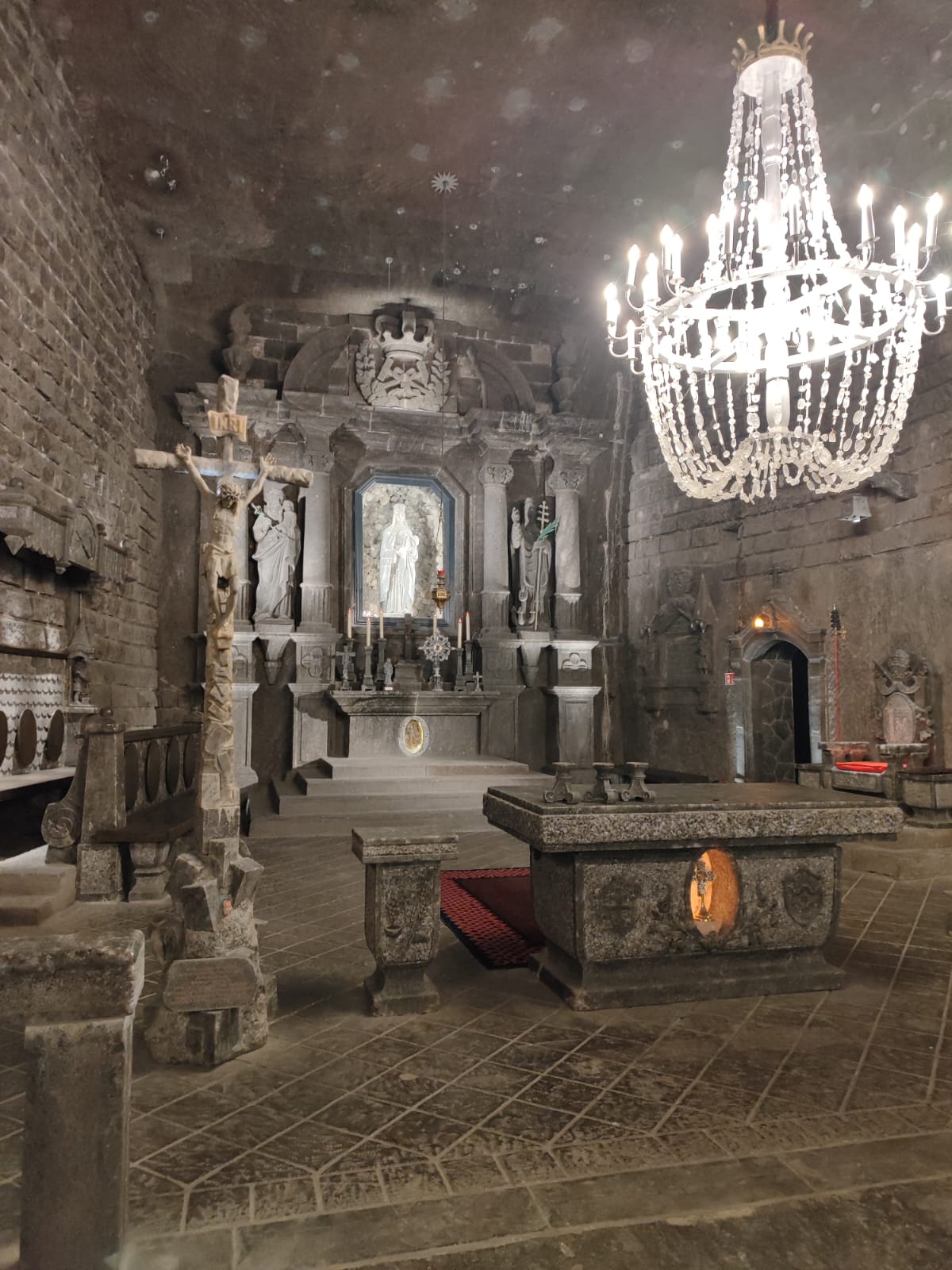
Even more impressive is the art miners created in these dark depths. Chapels, sculptures, chandeliers—all carved from salt. The most famous is St. Kinga’s Chapel, at 101 meters depth, a cathedral entirely made of salt. The reliefs on the walls, including Leonardo da Vinci’s Last Supper, are works of art. Miners never abandoned beauty, faith, and hope even while spending most of their days in darkness. The mine even has its own classical music composition.
Today’s Wieliczka: From Industrial Heritage to Experience Economy
Salt production ceased in 1996, but Wieliczka’s story didn’t end—a new chapter began. Actually, this is the part that interests me most.
Now this magical underground world welcomes approximately 1.2 million visitors annually (Wieliczka Salt Mine, 2024). Tourists from all over the world descend to depths of 135 meters, embarking on a 3.5-kilometer journey.
Yes, we also took a tour lasting nearly 3 hours in the underground passages with about 20 people including English, Italian, Spanish, Brazilian, and Czech visitors.
Professional guides greet you in many languages at the entrance. An English-speaking guide took us. Let’s give the man his due: fantastic presentation with occasional humor. As you descend, you can’t help but be enchanted. At every step, a new miracle appears: underground lakes formed from salt crystals, giant halls, old mining tools, and those magnificent chapels.
Even the air itself is different inside—thanks to salt’s healing properties, therapy is offered for asthma and respiratory patients (Chervinskaya & Zilber, 1995). At the exit, you eat a nice meal in the salt mine. Don’t worry! The exit is by elevator. But even the ascent is an example of organization and orderly presentation.
The underground has become a cultural center. Halls can be rented for special events, underground concerts, and even weddings are held there. Pope John Paul II also held mass here (being Polish, the Pope apparently holds great importance in this country).
You emerge from this tour like this: Wow!
Look what they’ve accomplished. You leave not just having seen a historical structure, but having felt the power of the human spirit and determination.
Product and Presentation in Tourism: The Wieliczka Model
In these days when we’re taking financial hits, we need real presentations. Of course, I don’t mean this financially. Tourism professionals understand. Countries that create good products and have strong presentations are receiving insane numbers of tourists in summer and winter. In fact, locals are now protesting saying “don’t come” (overtourism phenomenon) (Koens, Postma & Papp, 2018).
The Wieliczka example shows us this:
- Storytelling strengthens the product
- Professional presentation makes the experience unforgettable
- Multilayered value (cultural, historical, therapeutic) increases visitor satisfaction
- Sustainable transformation converts industrial heritage into tourism revenue (Timothy & Boyd, 2003)
A Proposal for Alanya: Herakles Museum – The God’s Power, The City’s Heritage
Starting from here, I want to make a proposal specific to Alanya.
We have products we can polish. We just need to put them under the spotlight and present them to the market.
For example: The unique Herakles (Hercules) Statue in Alanya Archaeological Museum.
I saw the breathtaking “Ephesus Experience Museum” in Ephesus. In that exhibition concept, the Artemis Statue and mosaics are supported by sound and light effects, digital projection mapping, and interactive panels (Ephesus Museum, 2022). They’ve solved this issue. It’s already a museum that received the European Museum of the Year Prestige Award (EMYA, 2011).
Herakles Museum: Alanya’s New Symbol
Imagine: “Herakles Museum – The God’s Power, The City’s Heritage” or “Herakles House – Guardian of the Empire.” You name it.
A museum supported by sound and visual effects, with holographic presentations of Herakles’ 12 labors, enriched with interactive experiences. If the original reliefs of the Herakles mosaics found in Syedra Ancient City are displayed digitally, when you say “Now go see the original in Syedra Ancient City,” there you have a destination tourism model (Leask, 2010).
Triple Destination Concept:
- Alanya Castle (existing attraction)
- Herakles Museum (new main attraction)
- Syedra Ancient City (connected destination)
Three rock-solid “must-sees, places you can’t leave without visiting.”
Why Only Herakles?
Look at other examples:
Denmark, Copenhagen: The Little Mermaid statue sitting on a rock. Come on! (A Yörük expression.) A mermaid emerging from the sea for a prince. It has a story. But nobody leaves without seeing it (Androula, 2007).
Belgium, Brussels: The Manneken Pis (Peeing Boy) statue. Come on! The boy neutralized a bomb by peeing on it. It has a story. Keychains, souvenirs, tons of products. The city’s symbol (Vandenborre & Brosius, 2020).
Compared to those, what about our HERAKLES!
Unparalleled in the world. Dating to the 2nd century BC, made with rare bronze casting technique, survived intact to the present day—a statue of Herakles, son of the mighty Zeus (Laflı, 2012). Man, no tourists know about this, or very few learn about it if their path happens to cross the museum.
This is the real story itself.
Marketing Reality: Product Quality Is Everything
Agencies look for products. They want to sell too. Just put quality, marketable products in front of them. Marketing is like this (Kotler, Bowen & Makens, 2014). No matter how much money you feed agencies, if the product isn’t good, it won’t sell. If the product is quality, it will come anyway. Even if you protest and demonstrate, they’ll break through and come (overtourism example).
The real promotion starts here.
“At home.”
In My Opinion, The Conclusion: Time to Get Your Own House in Order
First, get your own house in order. Get rid of toxins. Make your guests happy.
Present your product with its story.
Like Wieliczka—professionally, passionately, with faith.
But if only the sun remains, it will burn us all. We must evaluate our cultural heritage for sustainable tourism (McKercher & Du Cros, 2002).
Herakles is waiting. His story deserves to be told, deserves the spotlight. He deserves to be Alanya’s new symbol.
Yes Please.
Dr. Yakup Uslu
References
Androula, M. (2007). Cultural tourism: A sustainable approach to heritage tourism. Journal of Sustainable Tourism, 15(2), 131-147.
Ashworth, G., & Page, S. J. (2011). Urban tourism research: Recent progress and current paradoxes. Tourism Management, 32(1), 1-15.
Chervinskaya, A. V., & Zilber, N. A. (1995). Halotherapy for treatment of respiratory diseases. Journal of Aerosol Medicine, 8(3), 221-232.
Dobrowolski, K., & Tyszka, J. (2015). Wieliczka Salt Mine: UNESCO World Heritage Site. Wieliczka: Salt Mine Museum.
EMYA – European Museum of the Year Award. (2011). Special commendation: Terrace Houses, Ephesus Museum. European Museum Forum.
Ephesus Museum. (2022). Terrace Houses exhibition catalogue. Selçuk: Ephesus Museum Press.
Fog, K., Budtz, C., & Yakaboylu, B. (2005). Storytelling: Branding in practice. Copenhagen: Samfundslitteratur.
Koens, K., Postma, A., & Papp, B. (2018). Is overtourism overused? Understanding the impact of tourism in a city context. Sustainability, 10(12), 4384.
Kotler, P., Bowen, J. T., & Makens, J. C. (2014). Marketing for hospitality and tourism (6th ed.). Upper Saddle River, NJ: Pearson Education.
Laflı, E. (2012). The bronze statue of Heracles from Alanya. Mediterranean Archaeology, 25, 187-202.
Leask, A. (2010). Progress in visitor attraction research: Towards more effective management. Tourism Management, 31(2), 155-166.
McKercher, B., & Du Cros, H. (2002). Cultural tourism: The partnership between tourism and cultural heritage management. New York: Haworth Hospitality Press.
Pawlikowski, M., Loska, K., & Róż, A. (2015). Mineralogical and geochemical characteristics of the Wieliczka Salt Mine. Geology, Geophysics & Environment, 41(1), 71-81.
Thiel, T. (2010). Miners’ art and religious devotion in the Wieliczka Salt Mine. Material Religion, 6(2), 224-245.
Timothy, D. J., & Boyd, S. W. (2003). Heritage tourism. Harlow: Prentice Hall.
UNESCO World Heritage Centre. (1978). Wieliczka and Bochnia Royal Salt Mines. Retrieved from whc.unesco.org
Vandenborre, G., & Brosius, J. (2020). Urban icons and tourist narratives: The case of Manneken Pis. Journal of Heritage Tourism, 15(3), 312-327.
Wieliczka Salt Mine. (2024). Visitor statistics 2023-2024. Wieliczka: Official Tourism Report.
Wollenberg, J. (2013). Salt mining in medieval Poland: Economic significance and technological development. Medieval History Journal, 16(1), 89-112.

Join The Discussion